

Preventing skin irritation from incontinence starts with three simple steps: keep skin clean, keep it dry, and apply a barrier cream after every change. Solid continence skin care done consistently stops most irritation before it develops. And frankly, most skin damage happens because no one explained how simple prevention is.
When skin stays wet for too long, the body’s natural barrier weakens quickly. Redness appears first, then soreness sets in, and before long, you are managing something far harder to treat. At Ontex Healthcare, we know how preventable most skin damage is.
This article walks you through why skin breaks down, how to spot the warning signs early, and which products and routines keep skin protected every day.
Here is what you need to know.
Why Incontinence Causes Skin Irritation
Incontinence causes skin irritation because urine and faeces break down the skin’s natural protective barrier when they come into contact with it. It sounds a bit technical, but bear with us.
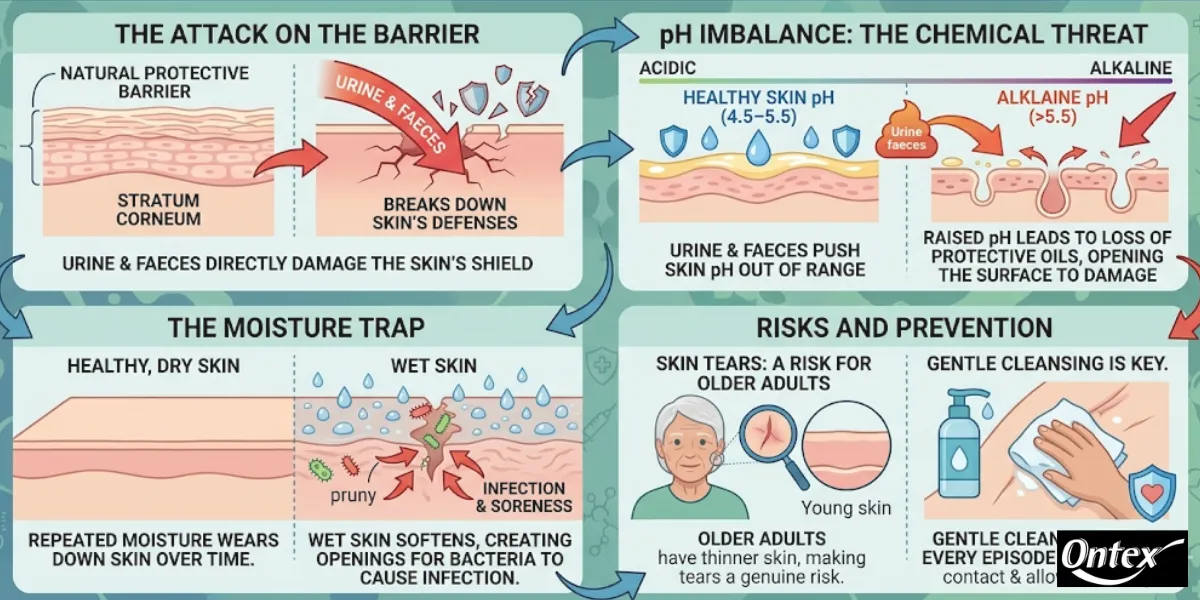
As we said earlier, when the skin is repeatedly exposed to moisture, it wears down over time. Once the barrier weakens, irritation, infection, and soreness follow quickly.
Let us break it down.
The Effect Urine and Faeces Have on Skin
Urine and faeces push skin pH out of its natural range (healthy skin pH sits between 4.5 and 5.5). When pH rises above that range, the skin loses its protective oils and leaves the surface open to damage. That is why cleansing skin gently after every incontinence episode cuts down chemical contact and gives skin a real chance to recover.
Why Moisture Is the Real Problem
Moisture is what keeps irritation going long after the initial contact. To be more specific, wet skin softens quickly, and that gives bacteria the perfect opening to cause infection.
What’s more, skin tears are a genuine risk for older adults whose skin is already thinner and more fragile. So keeping skin dry between changes is simply non-negotiable.
The Warning Signs Your Skin Is Struggling
Skin struggling under incontinence stress shows up in clear, visible ways, from redness and dryness through to open sores and raw, burning patches. Act on them early, and you avoid the harder, longer recovery that comes with advanced skin damage.
Watch for these signs every time you change.
- Redness and Warmth: Do not ignore red or warm skin. It indicates that moisture has already started breaking down the surface layer. In this situation, gently cleansing with a pH-balanced product and applying a barrier cream works well for managing the irritation.
- Dry or Flaky Patches: Many carers miss this early sign. Dry, peeling skin means the skin has already lost its natural oils. To help it recover, apply a fragrance-free moisturising cream after cleansing while the skin is still slightly damp.
- Open Sores or Rashes: Sores or rashes can appear when the skin stays exposed to moisture for too long. However, when they last more than a few days, it is a strong sign that incontinence-associated dermatitis has developed. And if you leave it without treatment, this can escalate into a serious infection. So see a GP as soon as possible.
- Raw or Hot Skin: Stinging or heat radiating is a sign that the protective barrier has completely gone. Only medical-grade treatment can rebuild it at this stage, so see a GP or continence health nurse straight away.
In practice, most of these signs respond well to simple treatment when caught at the first stage. Besides, we always recommend prevention over cure. That is exactly what’s up next.
How to Build a Continence Skin Care Routine
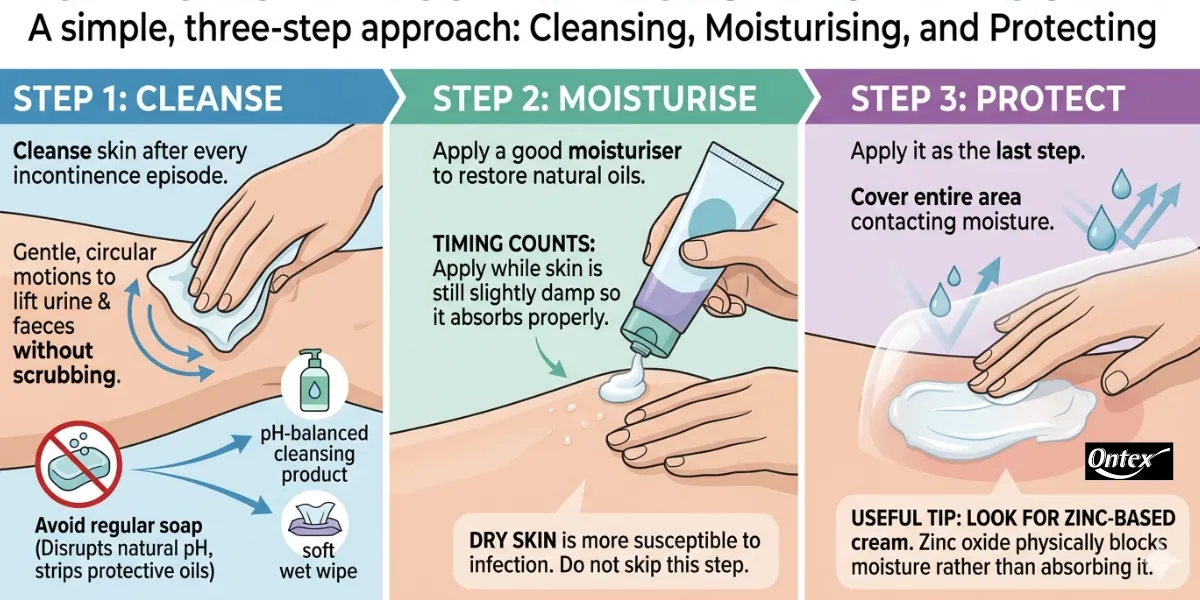
A simple three-step approach of cleansing, moisturising, and protecting covers everything your skin needs every single day. Believe it or not, it does not have to be complicated or time-consuming.
Here is how each step works in practice.
Step 1: Cleanse
Cleanse skin after every incontinence episode using gentle, circular motions to lift urine and faeces without scrubbing. However, be careful. Avoid regular soap because it disrupts the skin’s natural pH balance and strips away the protective oils that keep bacteria out. Instead, a friendlier option is a pH-balanced cleansing product or a soft wet wipe.
Step 2: Moisturise
Once skin is clean, apply a good moisturiser to restore the natural oils that moisture contact depletes. Timing counts here. You need to apply it while the skin is still slightly damp so it absorbs properly.
In short, dry skin is more susceptible to infection, so you cannot skip this step.
Step 3: Protect
Most carers cleanse and moisturise consistently but skip the barrier cream, and that is where skin becomes exposed. The solution is to apply it as the last step, covering the entire area that comes into contact with moisture.
Useful tip: Look for something zinc-based, because zinc oxide physically blocks moisture rather than just absorbing it.
Choosing the Right Barrier Cream and Cleansing Products
Using the correct barrier cream and cleansing products keeps skin dry, calm, and protected between changes. Not every product labelled “gentle” or “moisturising” is appropriate for skin dealing with repeated moisture contact.
This is what you need in your kit:
| Product Type | Purpose | When to Use |
| Barrier Cream | Creates a protective layer against moisture | After every cleanse and moisturiser |
| pH-Balanced Cleanser | Cleans skin without stripping natural oils | After every incontinence episode |
| Cleansing Foam | Gentle no-rinse option for sensitive skin | When water access is limited |
| Moisturising Cream | Restores natural oils and keeps skin supple | After cleansing, before barrier cream |
| Wet Wipes | Quick clean for skin between full changes | During the day for fast, gentle care |
Our experience with carers across Australia revealed that the most common mistake is reaching for a general body lotion instead of a purpose-built barrier cream. Unlike barrier creams, general lotions absorb into the skin.
That is why fragrance-free, dermatologically tested products are always the safer choice, especially for sensitive skin.
How Incontinence Products Help With Moisture Control
Incontinence products help with moisture control by pulling liquid away from the skin and locking it inside an absorbent core. The faster that happens, the less time moisture spends against the skin.
Some products manage this far better than others, and skin pays the price for a poor choice. For instance, products with a moisture-wicking layer keep the surface feeling dry even after a leak, which cuts down the risk of skin breakdown throughout the day.
Fit plays into this, too. A poorly fitted product gaps at the edges, letting moisture pool against the skin instead of being drawn into the core. That undoes everything your cleansing routine works to prevent.
If you are not sure where to start, our team at Ontex Healthcare can help you find the right product for you
When to Ask for Help
If your skin is not improving after a few days of consistent care, it is time to get professional support involved.
Here are the situations where you need to get help.
- Sores That Do Not Heal: If you have skin sores that have not improved after a few days of consistent care, you need a GP or continence health nurse straight away.
- Recurring Skin Breakdown: When the same spot keeps breaking down despite a solid routine, it usually means something deeper is driving it. A professional assessment can identify whether it is a product issue, a technique issue, or an underlying health condition.
- Signs of Infection: Weeping, swelling, or an unusual odour coming from the skin area need medical treatment without delay. These are not symptoms a barrier cream can fix.
When simple routine changes don’t resolve recurring skin problems, a continence health nurse can assess your situation, identify gaps, and recommend products suited to your specific needs.
The Simplest Routines Do the Most Good
Skin irritation from incontinence is a real and painful problem for many Australians. But with the right care routine and products, it is entirely manageable day to day.
This article covered why irritation starts, how to spot the warning signs early, and the three-step continence skin care routine. In practice, small daily habits do far more for skin health than any treatment applied after damage appears.
At Ontex Healthcare, you’ll find a full range of skin care and incontinence products built for carers and their loved ones. Our team will take you through every option you need to protect your skin.
Your skin will thank you for it.